Posts

Showing posts with the label Pirola

First Documented Transmission of a Newly Minted Hybrid SARS-CoV-2 Variant

Image
In a recent case report, Swedish scientists documented the first known transmission of a novel recombinant SARS-CoV-2 variant. The case highlights how a patient co-infected with two different strains—sublineages of XBB (HV.1) and BA.2.86.1—generated and transmitted a hybrid variant to another patient within a hospital setting. In October 2023, routine genomic surveillance in Stockholm identified a recombinant variant in a patient (Patient B). This hybrid virus combined genetic material from two distinct lineages: the 5′ part of the genome from HV.1 and the 3′ part from BA.2.86.1. The recombination occurred at the orf1b and S gene junction, producing a novel variant not observed in other Swedish patients. Meanwhile, another patient (Patient A), co-hospitalized in the same ward, was found to be co-infected with both HV.1 and BA.2.86.1. Sequencing revealed that about 30% of the virus in Patient A came from the BA.2.86.1 lineage. The two patients shared six rare mutations, confirming that ...

The offshoots of JN.1 in the Evolutionary Trajectory of COVID-19

Image
While the current SARS-COV-2 viral activity levels may seem reassuring ( back to the levels seen in October-November 2023 ), the evolving world of JN.1 offshoots, where the next generation of variants is taking shape, presents a compelling case for anticipating the potential challenges that lie ahead.  From the widespread presence of JN.1.16 across continents to the emerging dominance of JN.1.13 in the U.S., the current variant landscape is rapidly shifting, although the potential implications for the future are not quite clear.  The roots of the pandemic can be traced back to lineage A, with many initial sequences originating from China and subsequently spreading globally, including to regions such as South East Asia, Japan, South Korea, Australia, the USA, and Europe. Lineage B followed as the second major haplotype, with subsequent evolutions leading to the emergence of various sublineages. In 2020, we witnessed the emergence of variants such as Alpha (B.1.1.7) and Delta (...

Navigating the Tripledemic: JN.1, RSV, and Flu Update

Image
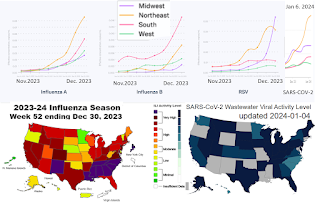
The respiratory viruses are out there.  Wastewater viral activity levels for COVID-19 , as reported by the Centers for Disease Control and Prevention, have reached the highest point since the Omicron surge in 2022. The levels are also high in Canada . The three primary respiratory illnesses continue to circulate at very high levels. But despite the triple threat of  SARS-Cov-2, respiratory syncytial virus ( RSV ) and the flu , there is a notable lack of community attention.   JN.1 (Pirola,  BA.2.86 ,  with additional L455S mutation, descending from a  de-escalated  variant of concern BA.2), initially detected on August 25 2023, has evolved from a variant under monitoring to a  variant of interest. Variants like Acrux (XBB.2.3, that began to spread worldwide soon after WHO declared the end of the pandemic) are  no longer relevant , but a few now less prevalent variants such as  Centaurus  (BA.2.75) and XBB, a hybrid of Centaurus wit...

COVID-19: November 2023 insights

Image
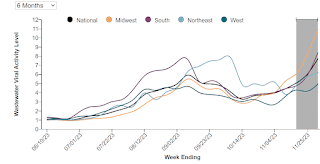
At a Congressional hearing on November 30, CDC Director Dr. Mandy Cohen highlighted a post-Thanksgiving rise in COVID-19 cases, a trend supported by wastewater monitoring.  The innovative  wastewater reporting dashboard , rolled out  in November ,  revamped by the CDC team "Poo's Clues," using SARS-CoV-2 viral RNA concentrations in wastewater, offer insights into the virus's spread, covering over 100 million people across 700+ sites.  A 12% increase in COVID-19 cases was observed from mid- to end of October, with regional variations. The Midwest and West saw significant surges, contrasting with the relative stability in the Northeast and South. By the end of November, West seemingly peaked but then continued upward, Northeast started catching up with Midwest, and numbers kept climbing nationwide  (another 11% increase by the end of November). ( Biobot data show even larger growth  in SARS Cov-2 number, ILInet also reports increasing levels of  in...

October's COVID-19 Impact

Image
On October 13, 2023, the golfing world lost an eleven-time PGA Tour winner Andy Bean. He was 70. His demise came six weeks after undergoing a double-lung transplant to address severe lung damage caused by a battle with COVID-19.  Born on March 13, 1953, Thomas Andrew Bean spent his formative years on the picturesque Jekyll Island, Georgia, before his family relocated to Lakeland, Florida. The move was inspired by his father Tommy's passion for golf, which led to the development of a golf course in Lakeland. Andy Bean's connection to the sport grew stronger as he went on to attend the University of Florida, where he played alongside teammates Gary Koch, Woody Blackburn, and Phil Hancock, helping the Gators secure the 1973 NCAA Championship.  Bean turned professional in 1975, embarking on a journey that would establish him as one of the PGA Tour's most consistent performers. Standing at an impressive 6-foot-4, Bean even gained notoriety for an incident where he "wrestled...

The Rise of Arcturus and Eris

Image
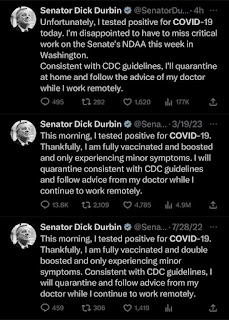
SARS-CoV-2, the virus responsible for COVID-19, is showing no signs of disappearing. In fact, the scientific community is in broad agreement that it is likely to remain a persistent part of our global health landscape for the foreseeable future. Just yesterday, U.S. Senator Dick Durbin tested positive for COVID-19 , a third time in the last 12 months. While new COVID-19 hospital admissions are at their lowest levels  - with fewer than two people per 100,000 being admitted - and continue to decrease, SARS-CoV-2 continues to spread. Unfortunately, as hospitalizations decrease, test positivity rates have begun to rise, indicating continued community transmission (see orange curve in the plot below). Historically, coronaviruses were relegated to the sidelines of viral research throughout the '80s and '90s. They were viewed as minor players because the common colds they caused seemed relatively insignificant on the grand scale of human health. However, in 2020, with the emergence of...