Posts

Showing posts with the label dermatological

Pilomatricoma at COVID-19 Vaccination Sites

Image
Pilomatrixoma, pilomatricoma, or calcifying epithelioma of Malherbe, is a common benign tumor originating from hair follicles. It has been noted to develop at COVID-19 vaccination sites. Case 1: Pilomatricoma Post-First COVID-19 Vaccination  A 65-year-old man experienced a growing pilomatricoma on his left upper arm, coinciding with the site of his initial COVID-19 vaccine. The tumor, appearing three months after vaccination, was 3 cm in diameter, mobile, and infection-free. Surgical removal confirmed pilomatricoma, identified by basaloid cells and keratinization. No recurrence was noted three months following surgery. Case 2: Subcutaneous Tumor Following COVID-19 Vaccination In this instance, a 43-year-old Japanese woman developed a subcutaneous tumor at her COVID-19 vaccination site. The tumor, emerging immediately post-vaccination, grew over five months. Dermatological examination showed a distinct, multilocular tumor with redness, and ultrasound imaging revealed a hypoechoic ma...

Neurological and Oral Complications Following COVID-19 Vaccination

Image
New paper discusses a case report of a 65-year-old woman who experienced neurological complications following the administration of a third dose of the Moderna COVID-19 vaccine. The patient, previously in good health, presented with symptoms that included numbness in the mouth, feet, legs, interscapular space, and hands, along with muscle pain in the lower limbs and interscapular pain. The clinical evaluation by a neurologist revealed distal and asymmetric sensory axonal polyneuropathy predominantly affecting the right lower limb. Electromyography (EMG) and electroneurography (ENG) tests were conducted to assess the nerve function. The study showed an exclusively sensory polyneuropathy of the axonal type with a distal and asymmetric distribution, predominantly in the right lower limb. There were also findings suggestive of neuropathy due to entrapment of the distal segment of the right median nerve in its course through the wrist.  The patient's blood work showed elevated transamin...

Reactivation of Epstein-Barr Virus Following COVID-19 Vaccination

Image
Epstein-Barr virus (EBV) is a common human herpesvirus that infects a majority of adults worldwide, typically transmitted through saliva during childhood. While most EBV infections are asymptomatic or cause mild symptoms, it can lead to conditions such as infectious mononucleosis (IM) in adolescents and young adults. Here we present two cases suggesting a potential link between EBV reactivation and COVID-19 vaccination.  Case 1 : EBV-Associated Lymphoproliferative Disorder: A 79-year-old male presented with fever, pancytopenia, elevated liver enzyme levels, and other alarming laboratory findings two weeks after receiving the first dose of the BNT162b2 mRNA COVID-19 vaccine. Further investigations revealed EBV viremia localized in natural killer (NK) cells, suggesting a diagnosis of EBV-NK-LPD. Despite aggressive treatment attempts, the patient's condition worsened, and he succumbed to the disease two months later. Case 2 : Cutaneous Manifestations and EBV Reactivation: A 24-year-ol...

Oral manifestations after COVID-19 vaccination

Image
A 38‐year‐old Thai woman developed painful oral lesions lasting over 8 weeks. The lesions appeared 1 week following the administration of the first dose of AZD1222 vaccine. Her extraoral examination was unremarkable. The intraoral examination revealed generalized desquamative epithelium, erythematous areas along the marginal gingivae and alveolar mucosa. Pseudomembranes, and erosions and ulceration on the buccal gingiva subjacent to the maxillary and mandibular teeth, and the right lingual dorsum could be seen. Furthermore, generalized desquamative epithelium of the alveolar mucosa of the anterior mandibular teeth as well as the right mandibular and left maxillary posterior molars extending to the mucobuccal folds were present. Erythematous areas also extended from the lingual gingiva of anterior mandibular teeth onto the floor of mouth. The histopathologic and direct immunofluorescence examination confirmed a diagnosis of pemphigus. After treatment with a potent topical steroid, fluo...

Multiple Keratoacanthomas Following COVID-19 Vaccination

Image
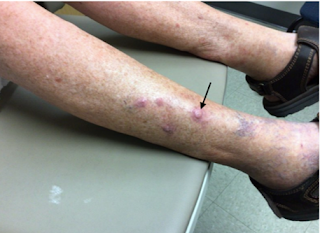
K er ato ac anth omas are a type of skin growth that can be found in people of any age or gender but are more common in older individuals. They are characterized by a raised , round , or dome - shaped les ion that is typically filled with a thick , yellow ish - brown crust y material . Ker ato ac anth omas are typically caused by sun exposure , chemical carcinogens , cancer drugs such as vemurafenib and diabrafenib, recent injury to the skin, and other factors such as genetics and hormonal changes . Human papilloma virus (HPV) has been also suggested as a causal factor. A new case report published in JMIR Dermatology describes a novel case of a healthy 86-year-old man who experienced an eruption of multiple keratoacanthomas 2 weeks after vaccination with the Moderna mRNA-1273 vaccine. 12 days after his second dose of the vaccine, he began to experience severe pruritus of the lower pretibial area, and within 2 days, he noticed red no...

Sudden onset of vitiligo after COVID‐19 vaccine

Image
A 33‐year‐old healthy female presented with a 45‐days history of milky‐white well‐demarcated, oval and liner‐shaped macules on her trunk, neck and back which had appeared 1 week after receiving her first dose of Pfizer‐BioNTech COVID‐19 vaccine. The second dose of vaccine was injected 1 months later without the appearance of new macules.  She had family history of vitiligo (father) but never suffered from it before.  Similar case was observed for a 13-year old girl with family history (father and paternal uncle).   Similar cases were reported 1 week after the first dose of Pfizer–BioNTech COVID‐19 vaccine in a 58‐year‐old man without family history for vitiligo suffering from ulcerative colitis 3.  A 69-year-old woman without personal/familiar history of vitiligo and other autoimmune diseases developed vitiligo several days after her first dose of Moderna (mRNA‐1273) COVID‐19 vaccine.  The macules progressed in size, number and degree of hypo...

Vulvar ulcers after COVID‐19 vaccination

Image
Multiple cases of  COVID-19  vaccine-triggered vulvar ulcers have been reported in medical literature.  A  12-year-old healthy girl  without prior sexual activity nor history of oral or genital ulcers presented with a 1-day history of vulvar ulcers with associated swelling and pain three days after receiving the second dose of the Pfizer COVID-19 vaccine.  Her condition resolved within 10 days after treatment.  A 12-year-old otherwise-healthy female patient presented with painful vulvar ulcerations that had been present for approximately 5 days, starting from 2 days after her 2nd Pfizer vaccine.  Ulcers healed over the course of 2 weeks after treatment.  A virginal 14-year-old girl reported vulvar pain and visible lesion. Exam findings were consistent with vulvar aphthous ulcers. Two days prior to the onset of her symptoms she received her second Pfizer-BioNTech COVID-19 vaccine. The evening of vaccine administration, she ex...

Systemic adverse reactions after the 5th dose of COVID-19 vaccine

Image
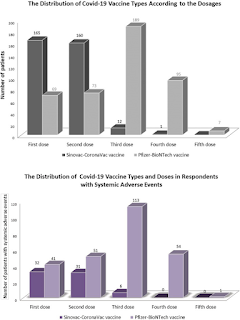
As fewer and fewer people opt for additional boosters of COVID-19 vaccine, are those who never had vaccine adverse events experiencing new side effects? VAERS reports many uneventful vaccinations even with extra doses given too soon after previous ones. Yet there are cases such as  abdominal pain , or Addisonian crisis  after the 5th dose. One case of systemic adverse reactions (14%, out of 7 respondents) was self-reported after the 5th booster in a survey-based study . The study also showed higher incidence of cutaneous reactions after 3rd vs 2nd dose of the same vaccine.  89 out of  234  vaccinated individuals  (38%)   who filled out  a web-based survey in Turkey  reported  at least one cutaneous adverse event related to the vaccination.  The responders cumulatively received 771 doses.  The mean number of vaccine dosages was 3.29 ± 0.76 (minimum:1, maximum:5). Sixty‐six (28.2%) cases had at least one accompanying systemi...

Total hair loss after COVID-19 vaccination

Image
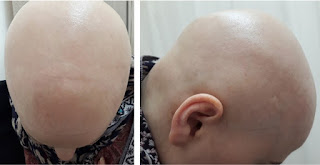
  A 23-year-old woman presented to the dermatology clinic with complaint of local hair loss on her scalp a week after receiving the first dose of Oxford/AstraZeneca COVID-19 vaccine (AZD1222) in August 2021. She also reported myalgia following the vaccination, which was relieved by acetaminophen. She had no past medical or family history of alopecia areata (AA) and had not received any medications. A positive pull test demonstrated oval-shaped patchy hair loss with defined borders and no scarring or scaling.   Treatment with betamethasone cream 0.1% and pimecrolimus cream 1% started immediately, but after 3 weeks, the patient returned with total hair loss on the scalp and eyebrows.  A diagnosis of Alopecia Totalis was made for her based on her history and physical characteristics, and treatment with systemic corticosteroid was initiated (oral prednisolone, 300 mg monthly, for 3 months).  Many more cases of males and females between the ages of 15 and 80 losing hair ...

Adverse Effects of Facemasks

Image
Quarantines, masking and physical distancing measures are needed to stop  Covid-19 pandemic  and save lives, but as the crisis drags on, new health challenges arise.    A 57-year-old female working as a kitchen aide had a history of migraine without aura since she was a teenager. Her past medical history included gastroesophageal reflux disease, a pituitary microadenoma and dyslipidemia. Before COVID-19, the characteristics of the pain were bifrontal, pulsatile and of moderate to strong intensity, with nausea, vomiting and photophobia. The frequency was 1 - 2 times per month, with relief provided by common pain medication such as ibuprofen. The pain was triggered by fatigue, cold weather and skin stimulation caused by hair accessories, caps, hats and glasses.  Her allodynia symptom checklist ASC12  was scored as 7 (sensitivity to necklace, glasses, tight clothes, ponytail, hair combing and exposure to cold), before March 2020 , when she began to work ...