Posts

Showing posts with the label 2nd dose

Acute and Long-term post-vaccinal complications
Image
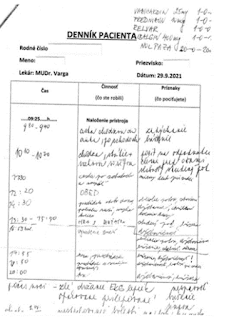
A person of unidentified gender and age received the second dose of the mRNA vaccine BNT162b2 (Comirnaty®) against COVID-19. The patient experienced acute complications such as myocarditis and exacerbation of bronchial asthma, as well as long-term complications such as postural orthostatic tachycardia syndrome (POTS). The treatment for the patient included various medications, regimen measures, pharmacotherapy and several nutraceuticals. The pharmacotherapies included metoprolol, ivabradine, corticosteroids, antihistamines, antiphlogistics, and bronchodilators. The nutraceuticals used were maritime pine bark extract, quercetin, vitamins, magnesium, and phosphatidylcholine.  There were no corresponding acute changes seen in the T1 and T2 maps, which are used to assess tissue characteristics. Handwritten note describes polymorphic patient complaints during 24-hour monitoring EKG (Department of Functional Diagnostics, UN - St. Michael's Hospital, a. s.; 29.9.2021) The patient's c...

Multiorgan Inflammation Following COVID-19 mRNA Vaccination

Image
A 14-year-old Japanese girl died unexpectedly 2 days after receiving the third dose of the BNT1262b2 mRNA COVID-19 vaccine. Autopsy findings showed congestive edema of the lungs, T-cell lymphocytic and macrophage infiltration in the lungs, pericardium, and myocardium of the left atria and left ventricle, liver, kidneys, stomach, duodenum, bladder, and diaphragm. Since there was no preceding infection, allergy, or drug toxicity exposure, the patient was diagnosed with post-vaccination pneumonia, myopericarditis, hepatitis, nephritis, gastroenteritis, cystitis, and myositis. Arrhythmia of atrial origin was assumed as the cause of cardiac failure and death.  Histopathology of the heart (left atrium), lung, liver, kidney, diaphragm, stomach, duodenum, and bladder of the child (Figure) show severe infiltration.  Multisystem inflammatory syndrome is a life-threatening condition associated with elevated inflammatory markers and multiple organ injury. A diagnosis of exclusion, it has...

Fatal Multiple Sclerosis After COVID-19 Vaccination and Infection

Image
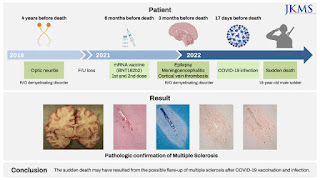
Multiple sclerosis (MS) is a chronic autoimmune disorder that affects the central nervous system, leading to a wide range of neurological symptoms.  While this disease is most commonly diagnosed in individuals in their 20s and 30s, it is rare for MS to result in sudden death in younger patients.  A 19-year-old male soldier received the second dose of the COVID-19 vaccine (Pfizer-BioNTech). 3 months later, he started experiencing epileptic seizures during sleep and was admitted to an outside hospital. Since the first seizure, he presented with 5 more generalized tonic-clonic seizures within a week. He had no other symptoms or signs of meningeal irritation. Cerebrospinal fluid (CSF) analysis including culture and viral polymerase chain reaction revealed no abnormalities except for mild pleocytosis. Oligoclonal band and aquaporin-4 antibodies were not detected in the CSF and serum. Brain MRI performed 1 day after the seizure revealed T2 hyperintensities in the periventricula...

Toothache as a side effect of vaccination

Image
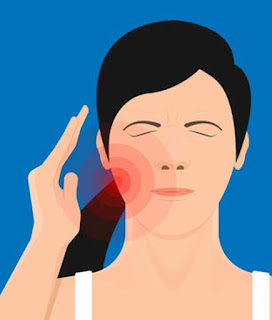
Previously we presented case reports with oral side effects of COVID-19 vaccine due to mucocutaneous reactions. Trigeminal neuralgia (TN) could be another reason for oral manifestations, including severe tooth pain.  A 45-year-old female was admitted to a research hospital with 3 days of facial and jaw pain, fatigue and toothache following the first dose of Pfizer-BioNtech vaccine against SARS-CoV-2. The features of the pain were unilateral, acute onset, and severe, on the lower right side of the face. It was triggering with brushing her teeth and putting on makeup. The case was considered as trigeminal neuralgia. Pregabalin failed to control the pain, while amoxicillin/clavulanic acid (despite normal X-rays) led to angioedema and worsening of her general condition. However, with steroid treatment, the patient eventually recovered.  A 36-year-old woman was admitted to the Emergency Ward due to chronic pain attacks in the left side of her face. The pain appeared tw...

Systemic lupus erythematosus myocarditis after COVID-19 vaccination

Image
A 72-year-old female underwent kidney transplantation in 2004 due to a chronic kidney failure secondary to membranoproliferative glomerulonephritis The patient has been in chronic hemodialysis since 2017 after renal graft dysfunction due to chronic rejection. She presented to the emergency room with pleuritic chest pain one week after vaccination with the third dose of BNT162b2 mRNA. Physical examination was unremarkable.  Despite no history of autoimmune diseases, her ANA IFA (a first line screen for detecting the presence of autoantibodies) was positive in 1:160 dilution, anti-dsDNA, and anti-histone antibodies were also positive. FDG PET/CT was requested, showing a focal myocardial and pericardial inflammatory process in the cardiac apex. Given the results, Systemic lupus erythematosus (SLE) diagnosis was made with myocardial affection. She was immediately started on oral prednisone (1 mg/kg) and beta-blockers improving clinically. At the three-month follow-up visit, the patien...

Ocular side effects of vaccination: neuroretinitis, MEWDS and more

Image
A 78-year-old healthy woman was presented with blurry vision in her left eye 1 day after receiving the third dose of the Pfizer-BioNTech COVID-19 vaccine. The ocular examination revealed an optic disc swelling and retinal thickening of the macula with subretinal fluid in the left eye. The fluorescein angiography revealed hyperfluorescence of the left optic disc. The neuroretinitis resolved gradually after taking azithromycin and prednisolone orally. unilateral neuroretinitis A 30-year-old female was diagnosed with bilateral acute anterior uveitis about a month after Pfizer COVID-19 booster vaccine and was started on prednisolone and cyclopentolate in both eyes. The symptoms had initially improved after a week of therapy, but a couple of weeks later she noticed that the visual acuity in the right eye precipitously dropped, which she described as “smoke” in her vision. She progressed to a serous retinal detachment involving the fovea in the left eye. Unilateral neuroretinitis is often ...

Vaccine-induced Myocarditis and Postural Orthostatic Tachycardia Syndrome

Image
A study published in January 2023 found that people who developed myocarditis after receiving a coronavirus vaccine had significantly higher levels of the virus's spike protein that was not bound by immune antibodies. It was also found in 10% of patients with chronic Hepatitis C up to 28 days after COVID-19 vaccination.  The spike protein may damage the heart's pericytes or endothelium by reducing the expression of the angiotensin-converting enzyme 2 (ACE2), reducing the production of nitric oxide in the endothelium, or activating integrin-mediated inflammation with hyperpermeability of the endothelial cell layer. The study prospectively collected blood from 16 patients with myocarditis who were hospitalized at two hospitals in Massachusetts (2 after the 1st dose, 12 after the second dose, and 2 after the 3rd dose) and compared the results to those from 45 vaccinated control subjects with no serious side effects. The individuals with myocarditis had essentially the same antib...

Oral manifestations after COVID-19 vaccination

Image
A 38‐year‐old Thai woman developed painful oral lesions lasting over 8 weeks. The lesions appeared 1 week following the administration of the first dose of AZD1222 vaccine. Her extraoral examination was unremarkable. The intraoral examination revealed generalized desquamative epithelium, erythematous areas along the marginal gingivae and alveolar mucosa. Pseudomembranes, and erosions and ulceration on the buccal gingiva subjacent to the maxillary and mandibular teeth, and the right lingual dorsum could be seen. Furthermore, generalized desquamative epithelium of the alveolar mucosa of the anterior mandibular teeth as well as the right mandibular and left maxillary posterior molars extending to the mucobuccal folds were present. Erythematous areas also extended from the lingual gingiva of anterior mandibular teeth onto the floor of mouth. The histopathologic and direct immunofluorescence examination confirmed a diagnosis of pemphigus. After treatment with a potent topical steroid, fluo...

Multiple Keratoacanthomas Following COVID-19 Vaccination

Image
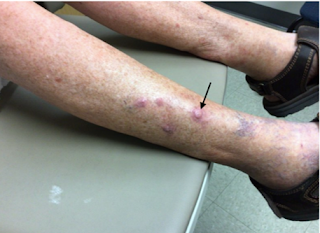
K er ato ac anth omas are a type of skin growth that can be found in people of any age or gender but are more common in older individuals. They are characterized by a raised , round , or dome - shaped les ion that is typically filled with a thick , yellow ish - brown crust y material . Ker ato ac anth omas are typically caused by sun exposure , chemical carcinogens , cancer drugs such as vemurafenib and diabrafenib, recent injury to the skin, and other factors such as genetics and hormonal changes . Human papilloma virus (HPV) has been also suggested as a causal factor. A new case report published in JMIR Dermatology describes a novel case of a healthy 86-year-old man who experienced an eruption of multiple keratoacanthomas 2 weeks after vaccination with the Moderna mRNA-1273 vaccine. 12 days after his second dose of the vaccine, he began to experience severe pruritus of the lower pretibial area, and within 2 days, he noticed red no...

ANCA-associated vasculitis

Image
Antineutrophil cytoplasmic antibody (ANCA)-associated vasculitis (AAV) is a  rare disease with an annual incidence of approximately 20 per million population in Europe and North America. The aetiopathogenesis is complex and is mainly driven by the gene environment interactions. Genes associated with this condition include HLA-DQ (variations in which have been linked to asymptomatic COVID), IL-5 and GPA33. COVID-19 heralds a poor prognosis in those with preexisting AAV with over 50% patients having severe disease. Loss of smell is observed in AAV population more frequently (~50%) than in others (~35%).  70-year-old Chinese woman presented  with poor appetite and nausea 4 hours after receiving the first dose of CoronaVac vaccine. These symptoms progressively worsened, followed by fatigue and foamy urine 10 days later. Her medical history included hypertension, hyperlipidemia, and kidney stones. She had penicillin allergy and no family history of ANCA-associated vasculitis...

Vulvar ulcers after COVID‐19 vaccination

Image
Multiple cases of  COVID-19  vaccine-triggered vulvar ulcers have been reported in medical literature.  A  12-year-old healthy girl  without prior sexual activity nor history of oral or genital ulcers presented with a 1-day history of vulvar ulcers with associated swelling and pain three days after receiving the second dose of the Pfizer COVID-19 vaccine.  Her condition resolved within 10 days after treatment.  A 12-year-old otherwise-healthy female patient presented with painful vulvar ulcerations that had been present for approximately 5 days, starting from 2 days after her 2nd Pfizer vaccine.  Ulcers healed over the course of 2 weeks after treatment.  A virginal 14-year-old girl reported vulvar pain and visible lesion. Exam findings were consistent with vulvar aphthous ulcers. Two days prior to the onset of her symptoms she received her second Pfizer-BioNTech COVID-19 vaccine. The evening of vaccine administration, she ex...

Negative VE and rVE against severe COVID-19 outcomes

Image
Several studies reported that COVID-19 vaccine effectiveness (VE) and relative vaccine effectiveness (rVE) against severe COVID-19 outcomes can turn negative after a few months.   One  recently published paper (data analyzed were from 8 December 2020 to 30 June 2021) concludes that For Doses 1 and 2 of ChAdOx1 and Dose 1 of BNT162b2, VE/rVE reached zero by approximately Days 60–80 and then went negative. By Day 70, VE/rVE was –25% (95% CI: –80 to 14) and 10% (95% CI: –32 to 39) for Doses 1 and 2 of ChAdOx1 (see Figure). The same trend was observed for BNT162b2 although it seemed to provide a better protection. Another not-yet published paper found that vaccine effectiveness was waning for all studied doses, including the 4th booster that worked for 90 days. Among health-care workers who had not had previous SARS-CoV-2 infection , time-specific vaccine effectiveness decreased from 52% (95% CI, 45 to 58) during the first 5 weeks after vaccination to −2% (95% CI,...

Systemic adverse reactions after the 5th dose of COVID-19 vaccine

Image
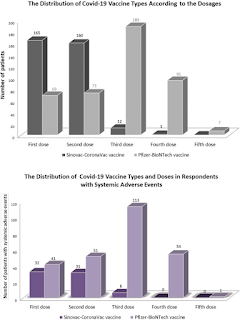
As fewer and fewer people opt for additional boosters of COVID-19 vaccine, are those who never had vaccine adverse events experiencing new side effects? VAERS reports many uneventful vaccinations even with extra doses given too soon after previous ones. Yet there are cases such as  abdominal pain , or Addisonian crisis  after the 5th dose. One case of systemic adverse reactions (14%, out of 7 respondents) was self-reported after the 5th booster in a survey-based study . The study also showed higher incidence of cutaneous reactions after 3rd vs 2nd dose of the same vaccine.  89 out of  234  vaccinated individuals  (38%)   who filled out  a web-based survey in Turkey  reported  at least one cutaneous adverse event related to the vaccination.  The responders cumulatively received 771 doses.  The mean number of vaccine dosages was 3.29 ± 0.76 (minimum:1, maximum:5). Sixty‐six (28.2%) cases had at least one accompanying systemi...