Posts

Showing posts with the label Vaccine effectiveness

Boosters, Bias and Math

Image
From vaccine math to biosafety preprints, recent studies reveal that unreported risks and hidden biases shape our understanding of COVID more than most headlines admit. Remember when getting vaccinated against COVID felt simple? One shot, maybe two, and you were done. Fast forward a few years, and we’ve had first doses, second doses, boosters, updated boosters, and debates about whether you need a booster for your booster . But a recent study crunching UK mortality data says: “Hold up. Maybe more shots aren’t adding as much protection as we think.” Add in your earlier research about antibody changes after repeated doses , and suddenly the COVID vaccine story feels less like “science is settled” and more like “science is a detective novel.” Let’s break it down in plain language. A.J. Oostenbrink’s new preprint looked at COVID and non-COVID death rates in the UK over two years. Instead of assuming COVID deaths rise proportionally with overall health risk, they used a formula: D covi...

Negative VE and rVE against severe COVID-19 outcomes

Image
Several studies reported that COVID-19 vaccine effectiveness (VE) and relative vaccine effectiveness (rVE) against severe COVID-19 outcomes can turn negative after a few months.   One  recently published paper (data analyzed were from 8 December 2020 to 30 June 2021) concludes that For Doses 1 and 2 of ChAdOx1 and Dose 1 of BNT162b2, VE/rVE reached zero by approximately Days 60–80 and then went negative. By Day 70, VE/rVE was –25% (95% CI: –80 to 14) and 10% (95% CI: –32 to 39) for Doses 1 and 2 of ChAdOx1 (see Figure). The same trend was observed for BNT162b2 although it seemed to provide a better protection. Another not-yet published paper found that vaccine effectiveness was waning for all studied doses, including the 4th booster that worked for 90 days. Among health-care workers who had not had previous SARS-CoV-2 infection , time-specific vaccine effectiveness decreased from 52% (95% CI, 45 to 58) during the first 5 weeks after vaccination to −2% (95% CI,...

Lower positivity rate among unvaccinated individuals compared to those who have received at least 1 dose of vaccine

Image
The more vaccinated you are (unless you got your last dose recently), the higher the chance you test positive?  Walgreen COVID-19 index is a surveillance system gathering COVID-19 diagnostic data from tests administered at 6,950 pharmacies across the United States and Puerto Rico. Diagnostic tests include drive-through Rapid Nucleic Acid Amplification tests (Rapid) and Polymerase Chain Reaction (PCR) tests; currently however, the Index only displays results from PCR tests. During the pre-Omicron era, the data demonstrated higher positivity rates among the unvaccinated group. However, in early 2022 the data indicated a lower positivity rate among unvaccinated individuals compared to those who have received at least 1 dose of vaccine. The vaccine effectiveness is in negative according to hospitalization and death data too. The figure above shows results as of July 5, 2022.  Walgreens data could be influenced by testing behavior though.  REFERENCE National Surveillance of ...

Omicron variants: is vaccine effectiveness in negative?

Image
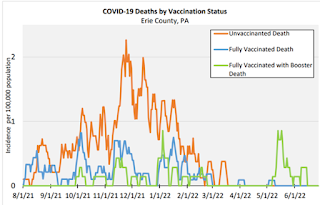
A n 18-year-old girl with no comorbidities died at the Government Thanjavur Medical College Hospital,  in Tamil Nadu, India,  on June 14.  Cause of death is COVID pneumonia, respiratory failure and cardiorespiratory arrest. The girl was admitted on June 14 at 7:15 am and declared dead at 2:30 pm the same day.  She had no fever at the time of admission, was conscious and had breathing difficulty. She was vaccinated with two doses of Covishield (Oxford/ Astrazeneca AZD1222) C19VAZ vaccine, formerly known as ChAdOx1 nCoV-1 ) and this was the first time she was infected by the virus. A June-28th report from Erie county , PA shows that some vaccinated and boosted individuals are dying from the latest variants of the virus.  Analysis of hospitalizations and deaths in the UK, showed  a significant increase in the case fatality rate (0.19% vs 0.41%; RR 2.11 [2.06-2.16], p<0.001) and odds of hospitalization  when comparing the period of February 28-May 1, 2...